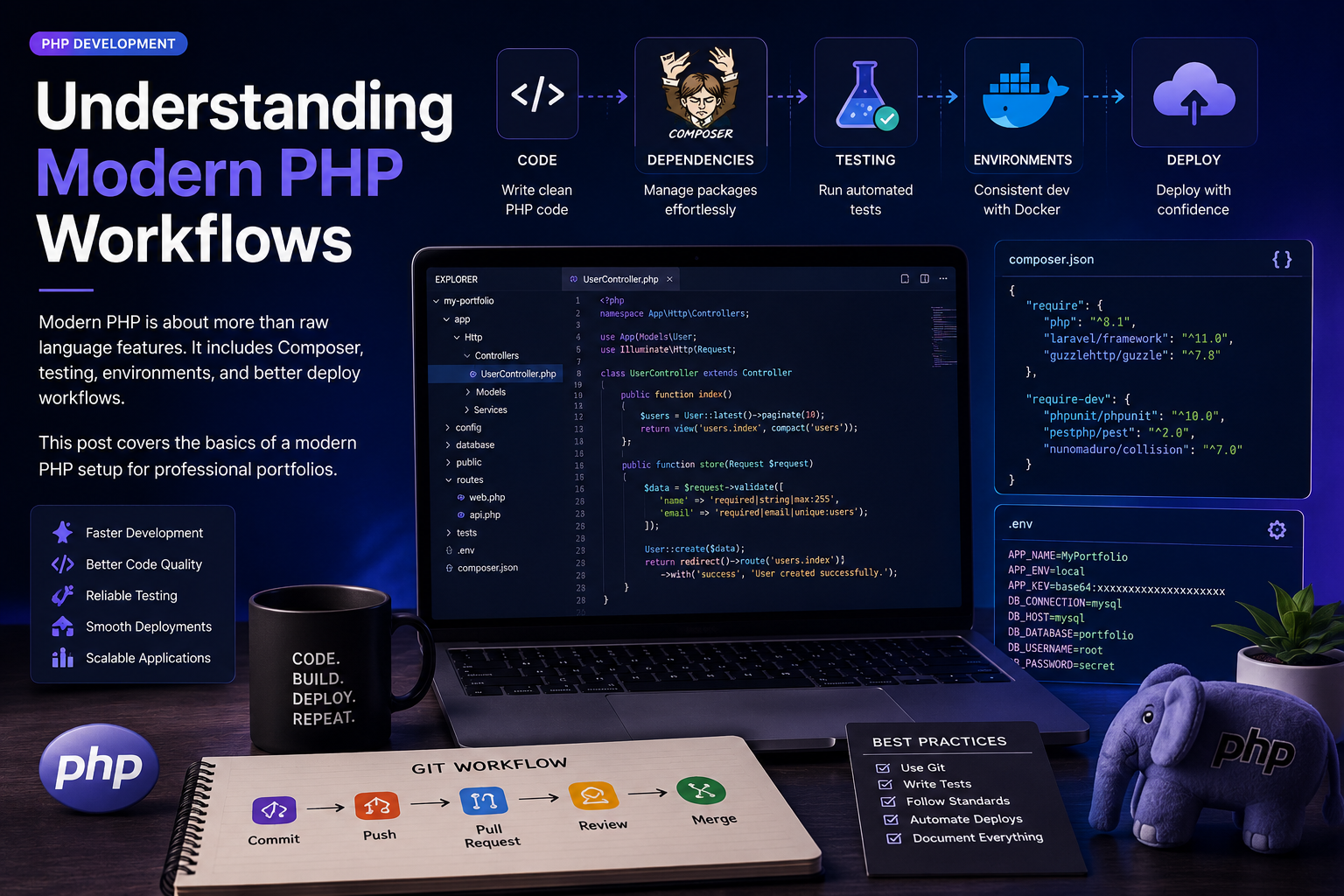
Understanding Modern PHP Workflows
PHP has evolved significantly over the years. Modern PHP development is no longer just about writing scripts and uploading files to a server. Today's professional PHP ecosystem includes dependency management, automated testing, containerized environments, continuous integration, and streamlined deployment processes.
Whether you're building a personal portfolio, a business application, or a large-scale web platform, understanding modern PHP workflows can dramatically improve code quality, maintainability, and team collaboration.
Why Modern Workflows Matter
Traditional PHP development often involved manually managing libraries, editing files directly on servers, and troubleshooting issues in production. While this approach can work for small projects, it becomes difficult to maintain as applications grow.
Modern workflows help developers:
- Write cleaner and more maintainable code
- Manage dependencies efficiently
- Detect bugs before deployment
- Create consistent development environments
- Automate repetitive tasks
- Deploy applications with confidence
Composer: The Foundation of Modern PHP
One of the most important tools in modern PHP development is Composer.
Composer is PHP's dependency manager and allows developers to install, update, and manage third-party packages with ease. Instead of manually downloading libraries, Composer handles package versions and dependencies automatically.
Common Composer use cases include:
- Installing frameworks like Laravel and Symfony
- Managing authentication libraries
- Adding API clients
- Integrating testing tools
- Keeping project dependencies organized
A typical project starts with a composer.json file, which defines the packages and requirements needed for the application.
Environment Management
Professional PHP applications rarely use hardcoded configuration values.
Instead, sensitive information such as:
- Database credentials
- API keys
- SMTP settings
- Application secrets
are stored in environment variables.
Using .env files allows developers to maintain different configurations for local development, staging, and production environments without modifying application code.
This approach improves both security and flexibility.
Automated Testing
Testing is a critical component of modern software development.
Tools like PHPUnit and Pest allow developers to verify that their applications behave as expected before releasing updates.
Testing typically includes:
Unit Testing
Validates individual classes and functions in isolation.
Feature Testing
Tests application features and business logic.
Integration Testing
Ensures multiple components work correctly together.
Automated testing helps catch bugs early and reduces the risk of breaking existing functionality.
Code Quality and Standards
Maintaining a consistent codebase becomes easier when teams follow established coding standards.
Popular tools include:
- PHP CodeSniffer (PHPCS)
- PHP-CS-Fixer
- PHPStan
- Psalm
These tools automatically identify formatting issues, potential bugs, and type-related problems before code reaches production.
Local Development Environments
Modern PHP projects aim to create environments that closely match production systems.
Common solutions include:
Docker
Docker provides isolated containers that package:
- PHP runtime
- Web server
- Database
- Supporting services
This ensures every developer works in a consistent environment regardless of operating system.
Local Development Tools
Framework-specific tools such as Laravel Herd, Laravel Sail, and Valet simplify local development and setup.
Version Control with Git
Git has become an essential part of every professional development workflow.
Version control enables developers to:
- Track changes
- Collaborate effectively
- Create feature branches
- Review code through pull requests
- Roll back problematic updates
Platforms like GitHub, GitLab, and Bitbucket provide powerful collaboration and repository management features.
Continuous Integration and Deployment (CI/CD)
Modern teams automate testing and deployment using CI/CD pipelines.
A typical workflow includes:
- Developer pushes code to Git.
- Automated tests run.
- Code quality checks execute.
- Build process completes.
- Application deploys automatically.
Popular CI/CD platforms include:
- GitHub Actions
- GitLab CI/CD
- Jenkins
- CircleCI
Automation reduces deployment errors and speeds up release cycles.
Modern PHP Frameworks
Frameworks such as Laravel and Symfony have embraced modern development practices and provide built-in support for:
- Dependency injection
- Routing
- Authentication
- Queue processing
- Testing
- API development
These frameworks allow developers to focus on business logic instead of reinventing common functionality.
Building a Professional PHP Portfolio
If you're creating a PHP portfolio project, consider including:
- Composer-managed dependencies
- Environment configuration
- Automated tests
- Git version control
- Docker support
- CI/CD workflows
- Clean documentation
Demonstrating these practices shows employers and clients that you understand real-world development processes beyond simply writing code.
Final Thoughts
Modern PHP development is about creating reliable, scalable, and maintainable applications using proven tools and workflows. Composer, testing frameworks, environment management, Git, Docker, and automated deployment pipelines have transformed PHP into a powerful ecosystem for professional software development.
By adopting these practices early, you'll not only build better applications but also prepare yourself for modern development teams and production environments.